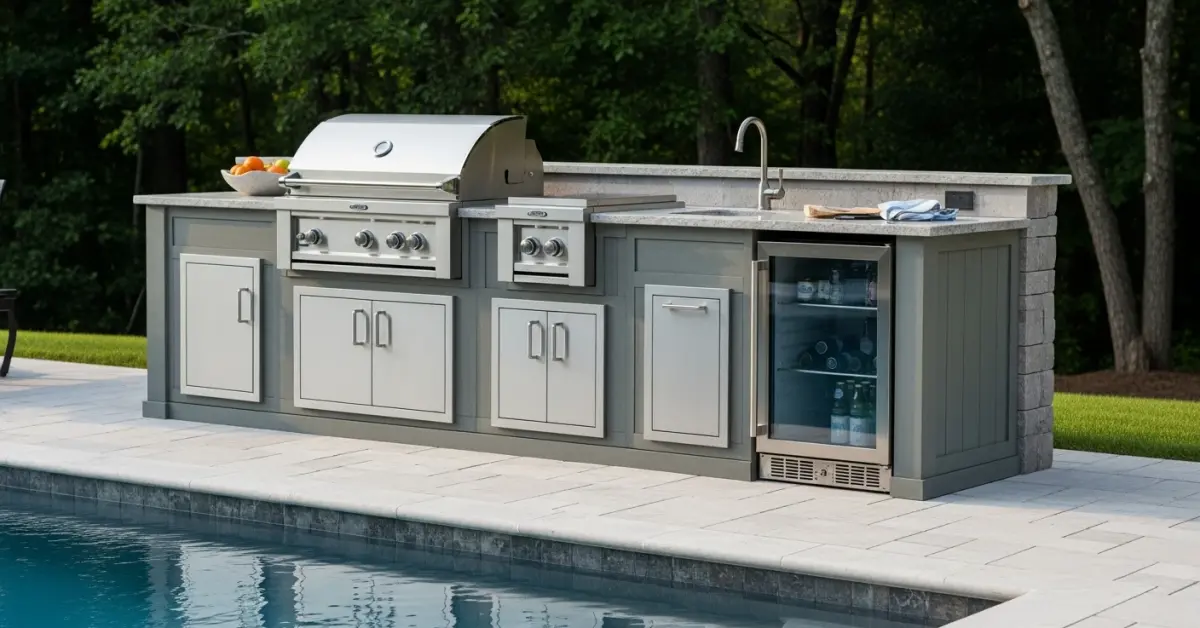
In my 15 years designing and building outdoor kitchens here, the single biggest differentiator for a project in
In my 15 years designing and building outdoor kitchens here, the single biggest differentiator for a project in Sarasota is engineering for moisture and salt. A beautiful design will fail in under five years if it's not built with materials and techniques specifically for our coastal climate. The conversation must start with 316-grade stainless steel, marine-grade polymer or concrete cabinetry, and non-porous, UV-resistant countertops. Anything less is a planned obsolescence that I refuse to build because I've seen the costly repairs that follow.
- Material Science is Non-Negotiable: Standard 304-grade stainless steel will show surface rust (tea staining) in Sarasota; 316-grade (marine grade) is the baseline requirement.
- Structural Integrity for Wind Load: Projects must be anchored to meet Sarasota County's wind load requirements, especially in exposed coastal areas like Longboat Key.
- HOA Compliance is Paramount: Architectural Review Committees (ARCs) in communities like Lakewood Ranch have specific mandates on materials, colors, and placement that must be addressed in the initial design phase.
- Ventilation is a Code Requirement: A common oversight is improper ventilation for gas grills built into combustible structures, a critical safety and code compliance issue we always engineer for.
The Planning Failures That Compromise Sarasota Outdoor Kitchens
The most common mistake I see is underestimating the corrosive power of our salty, humid air. A client selects a beautiful set of outdoor-rated appliances and cabinets that would perform perfectly in a dry climate like Arizona, but here, they begin to degrade quickly. The failure isn't in the product itself, but in its application in the wrong environment.
Another frequent issue is a design that ignores the sun's path. Homeowners will place a refrigerator in a location that gets blasted by the afternoon sun, causing it to run constantly and fail prematurely. Or they'll choose a dark granite countertop that becomes too hot to touch for half the day. Proper site planning in Sarasota is as much about managing the elements as it is about workflow and aesthetics.
The Most Expensive Oversight: Ignoring Water Management
The costliest error is failing to plan for water. This isn't just about rain. It's about humidity, condensation, and drainage. I was brought in to assess a two-year-old outdoor kitchen in a beautiful home near Phillippi Creek. The cabinet interiors were riddled with mold, and the tongue-and-groove ceiling was warped. The original builder didn't incorporate proper ventilation within the cabinetry or a drainage plane behind the structure. The entire six-figure project had to be torn out because moisture became trapped, leading to systemic failure. Proper design anticipates water from every source.
The Construction Process in Practice
Building a custom outdoor kitchen in Sarasota County is a multi-stage process that begins long before any ground is broken. It starts with a site assessment to understand sun exposure, prevailing breezes, and utility access. From there, we move to a design phase where material selection is guided by the home's proximity to saltwater and the specific rules of the local HOA.
Once a design is finalized, we produce engineered drawings for permitting. These plans detail everything from the concrete footing and blockwork to the electrical layout and gas line specifications. The permit is submitted to the Sarasota County Planning and Development Services, a process that can take anywhere from four to eight weeks, depending on their workload. Only after the permit is issued can construction begin, followed by a series of inspections for footing, electrical, plumbing, and the final build.
Key Selection Criteria for Sarasota Homeowners
- Verify the contractor's experience with projects specifically on the barrier islands (Siesta Key, Longboat Key, Lido Key) versus inland. The material and fastening requirements are different.
- Ask to see their Sarasota County license and proof of liability and workers' compensation insurance. A state-level registration is not enough for structural work.
- Request a detailed material specification sheet. It should explicitly state the grade of stainless steel (316), the type of cabinet material (e.g., marine-grade polymer), and the manufacturer of all components.
- Confirm they handle the entire permitting process, including submissions and scheduling inspections. This should not be the homeowner's responsibility.
Comparing Custom-Built vs. Modular and Pre-Fab Kits
Homeowners often weigh the benefits of a fully custom-built kitchen against modular or prefabricated options. While pre-fab kits can seem faster and more affordable upfront, the trade-offs in our specific climate are significant. I've seen modular units with steel frames rust out from the inside because they weren't designed for our humidity and salt air.
| Feature | Fully Custom-Built | Modular Units | Prefabricated Kits |
|---|---|---|---|
| Durability in Salt Air | Excellent (with 316 steel & marine-grade materials) | Variable to Poor | Often Poor |
| HOA Compliance | Designed to meet specific ARC guidelines | May require modifications or be rejected | Often non-compliant |
| Hurricane Resistance | Engineered and anchored to local code | Depends on installation quality | Typically not rated for high winds |
| Design Flexibility | Unlimited | Limited by component sizes | Fixed design |
| Typical Investment | $25,000 - $100,000+ | $10,000 - $30,000 | $5,000 - $15,000 |
When a Full Custom Kitchen Is Not the Right Choice
A fully integrated, custom-built outdoor kitchen is not the best solution for every situation. If you are in a home you don't plan to stay in for more than five years, the return on investment may not be realized. In this case, a high-quality, freestanding custom grill and well-chosen outdoor-rated furniture can provide excellent functionality without the permanence and cost of a built-in structure. It's a pragmatic choice that acknowledges the realities of the real estate market.
Safe Hiring Checklist for Your Sarasota Project
Hiring the right team is the most critical step. A slick salesperson can sell a beautiful design, but it takes a seasoned builder who understands the local environment to execute it properly. I've seen too many projects where the details that ensure longevity are skipped to save a few dollars.
- Verify Florida State and Sarasota County Licensing: Check the Florida Department of Business and Professional Regulation (DBPR) for a certified contractor license (e.g., Certified General, Building, or Residential Contractor). A simple 'handyman' license is insufficient for this scope of work.
- Request a Certificate of Insurance: They must provide a current Certificate of Liability Insurance and proof of Workers' Compensation coverage directly from their insurance agent. Do not accept a copy from the contractor.
- Review a Portfolio of Local Work: Ask for addresses of projects completed at least three years ago in coastal Sarasota. This allows you to see how their work holds up to the elements over time.
- Insist on a Detailed Scope of Work: The contract should specify every material, appliance model number, and construction detail. Ambiguity in the contract almost always benefits the contractor, not the client.
- Understand the Payment Schedule: Payments should be tied to completed project milestones (e.g., foundation poured, framing complete, final inspection passed). Never pay more than 10% or $1,000 (whichever is less) as an initial deposit, as per Florida law for most contracts.
- Confirm They Will Pull the Permit: The licensed contractor performing the work must be the one to pull the permit. If a builder asks you, the homeowner, to pull the permit, it is a massive red flag.
Decisions That Define the Project's Success
The success of a custom outdoor kitchen in this area boils down to a few key decisions made at the very beginning. The first is committing to a budget that allows for the right materials. Opting for cheaper alternatives to save 15-20% upfront almost guarantees you will spend far more on repairs and replacements within a few years.
The second critical decision is choosing function over sheer size. A well-designed, compact kitchen with high-quality, weather-resistant components is infinitely more useful and durable than a sprawling one built with mid-grade materials. I often advise clients to invest in a top-tier grill and proper storage and sacrifice a secondary burner or oversized sink they'll rarely use. It's about strategic allocation of resources.
The Moment Most Homeowners Get It Wrong
The critical mistake happens during the appliance selection phase. A client will see a beautiful outdoor refrigerator or set of access doors online or in a big-box store, often at an attractive price. The error is assuming 'outdoor-rated' means 'Sarasota-rated.' Many of these products are made with 304-grade stainless steel, which is simply not sufficient for our environment. We insist on specifying components from manufacturers who explicitly warranty their products for coastal applications and use 316L or marine-grade materials. This single decision point separates a kitchen that looks great for a decade from one that starts showing corrosion in its first year.
Practical Answers for Building in Sarasota
Navigating the local requirements is a key part of my job. Clients are often surprised by the level of detail and scrutiny involved, but these regulations are in place to ensure safety and structural integrity in a hurricane-prone region.
What is the permit process for an outdoor kitchen?
In Sarasota County, any outdoor kitchen with permanent utility connections (gas, electric, or plumbing) requires a building permit. The process involves submitting engineered plans that show the foundation, structural components, and all utility schematics. These plans are reviewed for compliance with the Florida Building Code, including specific wind-load and electrical requirements. The cost for a permit can range from $400 to over $1,000, depending on the project's total value.
How do HOA architectural committees impact the design?
Most master-planned communities in Sarasota, like The Concession or Palmer Ranch, have an Architectural Review Committee (ARC) with significant authority. They dictate materials, color palettes, and even the location of the kitchen on your property. We must submit our complete design package, including material samples, to the ARC for approval before we can even apply for a county permit. Ignoring this step can lead to fines and forced removal of the structure.
Are there specific utility codes I should know about?
Yes, and they are strict. For natural gas or propane lines, all piping must be properly supported and bonded, and a pressure test is required during inspection. For electrical, all outlets must be GFCI-protected and housed in weatherproof 'in-use' covers. We also have to adhere to specific clearance requirements, ensuring the grill and any side burners are a safe distance from combustible materials like wood siding or soffits, a detail that is often missed in DIY or inexperienced installations.